
Social Skills Groups for Teens, Rockwall TX
Written by: Christian Graves, Licensed Professional Counselor-Associate, at Dr. Vaccaro Counseling Group, Rockwall TX
Social Skills Groups for Teens, Rockwall TX
Being a teenager can be awkward.
They are figuring out who they are, trying to make friends, navigating changing relationships, learning how to communicate what they need, and somehow expected to understand all of the unspoken rules of being a teenager.
And just when they think they have figured something out… someone changes the rules.
For neurodivergent teens, some of those social rules can feel even harder to navigate. Starting a conversation, knowing when to join in conversations, understanding friendship dynamics, managing big emotions, or figuring out what to say when something feels uncomfortable can take extra practice.
That is where social skills groups for teens can make a meaningful difference. Social interaction is a skill. Communication is a skill. Managing emotions is a skill. Even things like starting a conversation or knowing how to ask for help are skills… And skills can be practiced.
Research supports the value of structured social skills groups for neurodivergent children and adolescents.
What Do Teens Actually Learn in a Social Skills Group?
At our practice, social skills groups are much more than sitting around a table and being told how to make friends.
We make the skills practical, interactive, and relevant to situations teens actually experience.
Communication Skills
Communication is about more than just talking.
In group we practice how to express feelings, ask for what you need, listen to someone else, communicate boundaries, and speak up when something doesn’t feel right.
For some teens, speaking up can feel incredibly uncomfortable, or maybe they just don’t know where to start or when to speak up. Practicing in a supportive, safe group can make it easier to eventually use those skills outside of the group. Research and feedback proves this to be true!
Building Conversations
“How do I start a conversation?”
“What do I say next?”
“How do I keep this from getting awkward?”
Some might assume that everyone naturally knows how to hold a conversation, but things like starting a conversation, keeping it going without it fading out, and recognizing cues for when to wrap it up are actually learned skills.
These are questions many teens have, even if they don’t always say them out loud. These are learned skills.
We practice conversation-building skills such as asking follow-up questions, showing interest, finding common ground, and recognizing opportunities to keep a conversation going.
Sometimes we even turn it into a game. Because practicing conversation skills shouldn’t feel like homework.
Understanding Feelings
Social situations can bring up feelings. Good feelings, hard feelings, and everything in between.
Excitement. Anxiety. Embarrassment. Frustration. Jealousy. Disappointment. Confusion.
We spend time identifying feelings and recognizing what happens when those feelings show up. Teens learn how emotions can influence the way we communicate and respond to other people.
The goal isn’t to get rid of uncomfortable emotions. It is to become better at recognizing them and figuring out what to do with them.
Friendship and Relationship Skills
Teen relationships can get complicated quickly.
We talk about what makes a healthy friendship, how friendships can differ from romantic relationships, boundaries, respect, communication, and what to do when relationships become difficult.
These conversations give teens an opportunity to think through realistic situations before—or while—they encounter them in everyday life.
Executive Functioning Skills
Social skills and executive functioning often overlap more than we realize.
Being able to pause before responding, shift when plans change, remember what someone just said, manage emotions, prioritize tasks, and think through the possible outcome of a decision all require executive functioning.
That means social skills groups can also be an opportunity to practice skills like flexibility, problem-solving, impulse control, planning, and emotional regulation.
Speaking Up for Yourself
One of the most important social skills we can teach is self-advocacy.
Teens need to know that it is okay to ask for help. It is okay to say, “I don’t understand.” It is okay to ask for an accommodation. It is okay to tell someone when a boundary has been crossed. And it is okay to communicate what they need. Sometimes they need a safe space to practice.
Social skills aren’t just about helping teens fit into social situations. They should also help teens feel more confident advocating for themselves within those situations.
Social Skills Groups for Teens – Is my teen a Good Fit?
So, who is a social skills group for teens actually for?
Honestly, there isn’t one specific type of teen who needs a social skills group.
Maybe your teen is having a hard time navigating friendships or relationships and isn’t quite sure how to get conversations started. Maybe they have a hard time knowing what to say next in a conversation to keep it going or understanding some of the unspoken rules of friendships. Maybe big feelings tend to take over during social situations and we shut down, or communication with friends can become frustrating. Or maybe you simply have a teen who could use a little more confidence and practice navigating the social world.
That’s where a teen social skills group can be helpful.
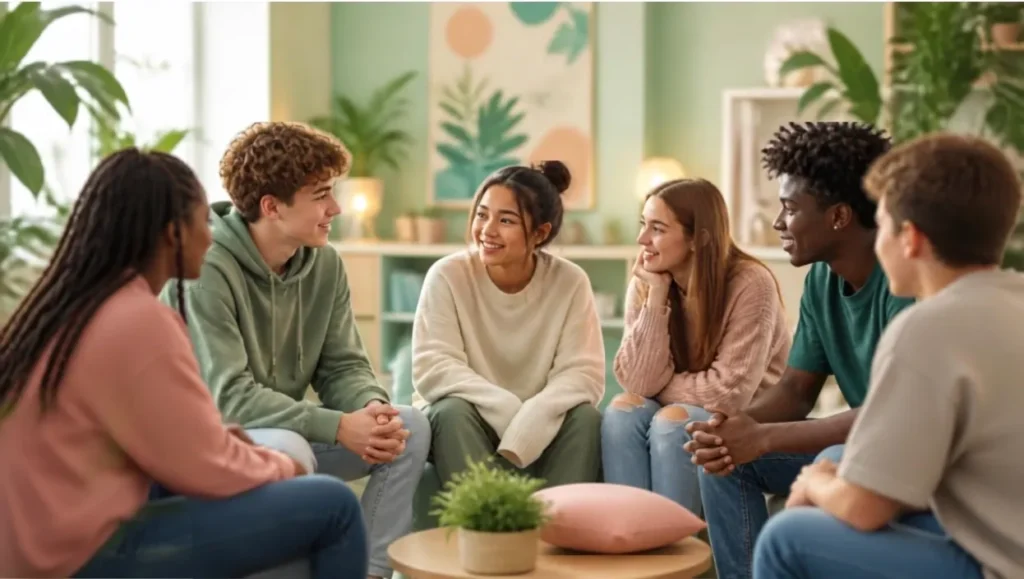
Group gives teens the opportunity to practice these skills with other teens, not just talk about them, I promise. They can work on communication skills, conversation building, emotional regulation, friendship skills, self-advocacy, and executive functioning skills in a supportive environment where they don’t have to get everything right the first time.
And sometimes, one of the best parts of group is realizing, “Wait… I’m not the only one who feels this way.”
We’ve been lucky enough to see some really great outcomes in our groups. We’ve watched teens become more comfortable speaking up, joining conversations, expressing their feelings, and connecting with others. We’ve also heard positive feedback from families who have noticed their teen becoming more confident and willing to use the skills they’ve practiced outside of group.
Those little moments can mean a lot.
Maybe it’s ordering their own food at a restaurant. Starting a conversation with someone at school. Telling a friend when something doesn’t feel right. Asking for help. Or simply feeling a little less nervous walking into a social situation.
Those are the moments we want to celebrate.
Because the goal of social and emotional skills for teens isn’t to make them act like everyone else. No masking here! It’s about helping them feel more confident being themselves while giving them the tools to communicate, connect, and navigate relationships in a way that works for them.
What to Expect During Group
Walking into a new group can feel a little intimidating, especially for a teen who isn’t always comfortable in new social situations. That’s why we want the first step to feel welcoming, low-pressure, and comfortable.
Before joining a group, we’ll start with a brief screening to get to know you and your teen, learn more about what they’re looking for, and make sure the group is a good fit for their needs and goals. We want everyone in the group to feel comfortable and supported, so finding the right fit matters.
Once the group begins, no two groups will look exactly the same. Each group will focus on different skills and topics based on the needs of the teens participating.
You can expect a mix of:
- Conversation and discussion – Talking through real-life situations, experiences, and questions teens may be navigating.
- Psychoeducation – Learning about things like communication, emotions, friendships, social cues, executive functioning, and self-advocacy in a way that actually makes sense.
- Games and activities – Because learning social skills doesn’t have to feel like sitting in a classroom. Interactive activities and games give teens a chance to practice skills while having fun.
- Real-life scenarios – Working through situations teens may encounter at school, with friends, at home, online, or in other social settings.
- Skill practice – Getting the opportunity to try out new communication and social skills in a supportive environment.
- Reflection and problem-solving – Talking about what worked, what felt uncomfortable, and what might be helpful to try differently next time.
Most importantly, there’s no expectation that your teen will walk in and immediately feel comfortable talking in front of everyone! Group at Dr Vaccaro Counseling is a place to practice at their own pace and in a safe place.
Our goal is to create a space where teens feel welcomed, respected, and understood, a place where they can ask questions, try something new, make mistakes, and learn alongside other teens who may be figuring out some of the same things.
And yes, there will definitely be some laughs along the way, too. Because social skills practice is a lot more helpful when it doesn’t feel like another assignment.
Group Counseling Therapy in Dallas, Rockwall, and Throughout Texas
At Dr. Vaccaro Counseling Group, we offer supportive, skills-focused social skills groups for neurodivergent teens throughout Dallas, Rockwall, Heath, and across Texas through secure telehealth services.
Our groups provide a welcoming space for teens to build communication skills, conversation skills, friendship skills, emotional regulation, executive functioning, and self-advocacy alongside peers who may be navigating some of the same challenges.
Because sometimes, knowing what to do isn’t the hard part. It’s knowing how to actually do it when you’re in the moment.
With the right support and a safe place to practice, teens can build confidence, strengthen their relationships, and develop practical skills they can carry with them into everyday life.
Social skills don’t have to be something your teen figures out alone.
Frequently Asked Questions
Does my teen need a diagnosis to participate?
Not necessarily. While social skills groups can be especially helpful for teens with a diagnosis such as autism spectrum disorder, ADHD, Depression, and Anxiety, they can also benefit teens who are working on communication, friendships, emotional regulation, or navigating social situations. We look at the individual teen and what they would like support with rather than simply focusing on a diagnosis.
What skills will my teen learn?
Every group is a little different depending on the teens participating and what they would benefit from. Some of the skills we may work on include conversation building, communication, understanding feelings, emotional regulation, friendship skills, self-advocacy, problem-solving, flexibility, and executive functioning skills.
What does a typical group session look like?
There isn’t really a “typical” session BUT that’s intentional! Groups may include a combination of conversation, psychoeducation, games, interactive activities, real-life scenarios, and opportunities to practice new skills. We want teens to actually use the skills rather than just hear someone talk about them.
Will my teen have to talk in front of everyone?
No. We understand that walking into a new group can feel uncomfortable, especially for teens who already feel anxious about social situations. We don’t expect everyone to jump right in on day one. Our goal is to create a safe and welcoming environment where teens can participate at a pace that feels comfortable while gradually building confidence.
What if my teen is nervous about joining?
That’s completely okay! In fact, that’s pretty common. Before joining a group, we’ll have a screening to get to know your teen, answer questions, and make sure the group feels like a good fit. We want the first step to feel comfortable rather than overwhelming.
Is this group therapy or just a social group?
Our social skills groups are a form of group counseling. While there is plenty of opportunity for connection and fun, the group also has therapeutic goals and focuses on developing practical skills that teens can use in their everyday lives.
How do you know if the group is right for my teen?
We start with a screening so we can learn more about your teen, what they’re experiencing, and what they’re hoping to work on. From there, we can determine whether a current or upcoming group is a good match. Finding the right group dynamic is important to us because we want everyone to feel comfortable, supported, and able to participate.
What if my teen needs more individualized support?
Group counseling isn’t the right fit for every teen, and that’s okay. Sometimes individual therapy, or a combination of individual and group therapy, may be more appropriate. If we feel your teen would benefit from something different, we’ll talk through those options with you and how we can continue to support you and your family.
Where does the group counseling take place ?
Our counseling group offers a large dedicated group space for up to 12 participants at a time sessions will predominantly take place in office, however, for some groups there will be opportunities to go apply skills in the community, such as walking to local cafés or interacting with one another in a more natural setting outside.
How do I find out about upcoming social skills groups?
The best place to start is by reaching out to Dr. Vaccaro Counseling Group. We can talk with you about upcoming groups for teens, what each group will focus on, and whether it may be a good fit for your teen.